

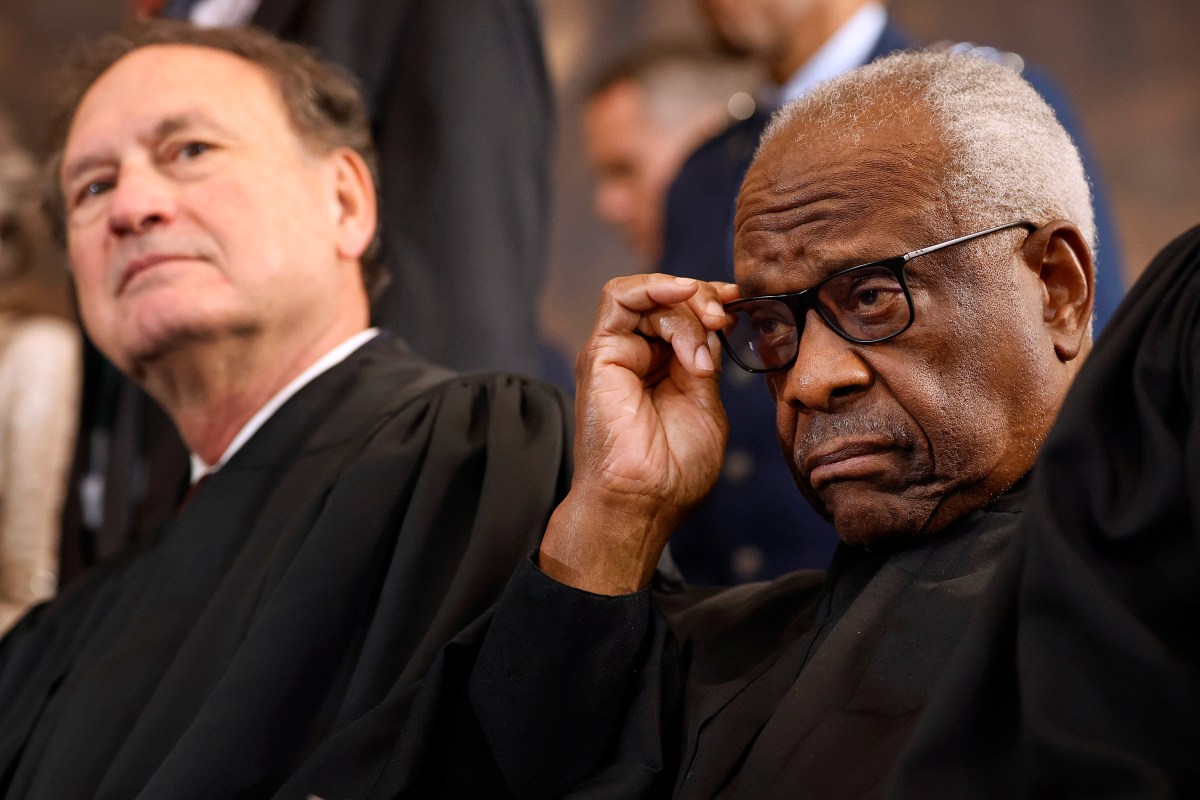
The Supreme Court on Monday declined to review a high-profile Alabama case involving a death row inmate, drawing a sharp dissent from Justices Samuel Alito and Clarence Thomas.
The decision leaves intact a lower-court ruling that threw out the capital murder conviction of Michael Anthony Powell due to controversial remarks made by a prosecutor during trial.
Powell was convicted and sentenced to death for the 2016 fatal shooting of a gas station clerk during a robbery. At trial, the defense emphasized that police never recovered the murder weapon. In his closing rebuttal, the prosecutor pointed at the defense table and stated, “There is only one person in this room who knows where the gun is.”
The Alabama Court of Criminal Appeals later overturned Powell’s conviction, ruling the comment was an unconstitutional violation of the Fifth Amendment right against self-incrimination because it improperly highlighted the defendant’s choice not to testify.
The State of Alabama petitioned the Supreme Court to summarily reverse the state court’s decision. On Monday, the Supreme Court majority denied the request, letting the reversal stand.
In a dissenting opinion joined by Thomas, Alito argued that the high court should have intervened to reinstate Powell’s conviction. Alito asserted that the prosecutor’s statement was a “perfectly proper” inference based on trial evidence—specifically, a forged confession letter Powell allegedly orchestrated to frame another inmate, which claimed the author had hidden the weapon. Viewed in that context, Alito argued, the remark was a fair response to the defense’s arguments rather than an unconstitutional penalty on the defendant’s silence.
“A prosecutor in this capital case made a statement in closing argument that the trial judge interpreted as a comment on properly admitted evidence. On appeal, however, the Alabama Court of Criminal Appeals interpreted the statement as a comment on the defendant’s failure to take the stand, and on that basis it reversed the defendant’s conviction… The State is right: The decision below contravenes [Supreme Court precedent], and this Court should summarily reverse it.”
The dissent underscores an enduring friction on the high court regarding the scope of constitutional protections during closing arguments. While the majority chose not to disrupt the state court’s findings, Alito and Thomas signaled deep concern that lower appellate courts are interpreting Fifth Amendment boundaries too strictly, altogether ignoring the real-world context of a trial to overturn valid convictions.
The ruling means Alabama must now either drop the capital charges or put Powell on trial for a second time.
This is a breaking news article. Updates to follow.










Leave a Reply