

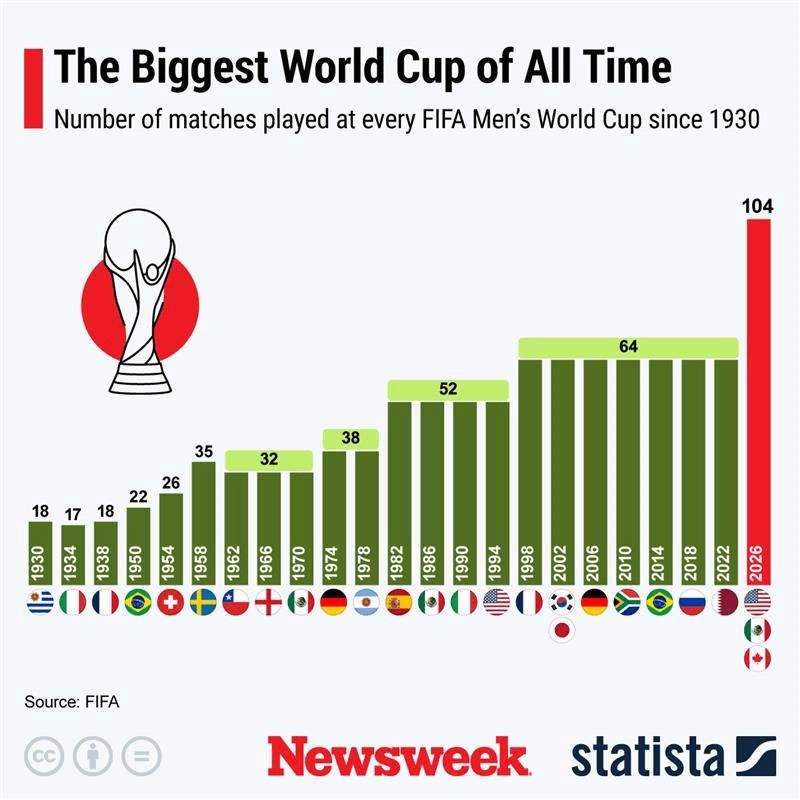
The 2026 FIFA World Cup is underway, and it is already the largest tournament in the competition’s history. A record 48 national teams are competing across 104 matches in the United States, Mexico and Canada, more than double the number of games played as recently as 1994.
The expansion marks the second major overhaul of the World Cup‘s format since 1930, when the first tournament featured just 13 teams playing 18 matches. FIFA‘s decision to grow the field from 32 to 48 teams reflects both a financial calculation and a push to include more countries on the sport’s biggest stage, even as critics warn the larger format risks diluting the quality of play.
When the Tournament Last Expanded
The last expansion came in 1998, when the field grew from 24 to 32 teams under then-FIFA president Sepp Blatter, producing 64 matches. That format held for 24 years, through the 2022 tournament in Qatar. Before that, the field grew from 16 to 24 teams for the 1982 tournament in Spain.
The jump to 48 teams in 2026 comes after just one cycle at 32 teams, a notably faster pace of expansion than in past decades.
Why FIFA Is Expanding to 48 Teams
Revenue is central to the decision. A larger field means more matches, more broadcast windows and more sponsorship inventory. It also means more national federations with a direct stake in the tournament, broadening FIFA’s commercial reach into new markets.
The three-host model for 2026, spread across the United States, Mexico and Canada, multiplies that effect further by distributing matches across dozens of cities and stadiums, each generating its own ticket sales, tourism revenue and local economic activity.
The Expansion in Numbers
The financial scale of the 2026 tournament dwarfs previous editions. FIFA is expected to generate roughly $11 billion in total revenue from the World Cup, driven largely by broadcasting rights.
With the field expanded to 48 teams and 104 matches, FIFA projects around $3.9 billion from broadcasting alone, an increase of roughly 30 percent over the 2022 tournament in Qatar, according to Simon Chadwick, a professor at Emlyon Business School who studies the business of soccer.
Ticket pricing has shifted just as sharply. The cheapest seats at the 2022 World Cup in Qatar started around $55. For 2026, comparable seats in widely available categories have climbed to roughly $560, nearly 10 times higher. FIFA has pointed to a “supporter entry tier” priced around $60, though those tickets make up only about 10 percent of each participating nation’s allocation.
FIFA President Gianni Infantino has defended the approach by emphasizing FIFA’s nonprofit status, saying revenue generated through the World Cup is reinvested across the organization’s 211 member associations.
Criticism of the Expansion
Critics argue a 48-team field dilutes competitive quality, producing more lopsided group-stage matchups between top-ranked teams and lower-ranked newcomers.
The additional matches also raise concerns about player workload, particularly for players whose club seasons already stretch nearly year-round.
UEFA President Aleksander Čeferin has criticized further expansion proposals, calling a 64-team World Cup “a bad idea”, a sentiment that echoes broader concerns about the tournament growing too large too quickly.
How the World Cup Has Evolved
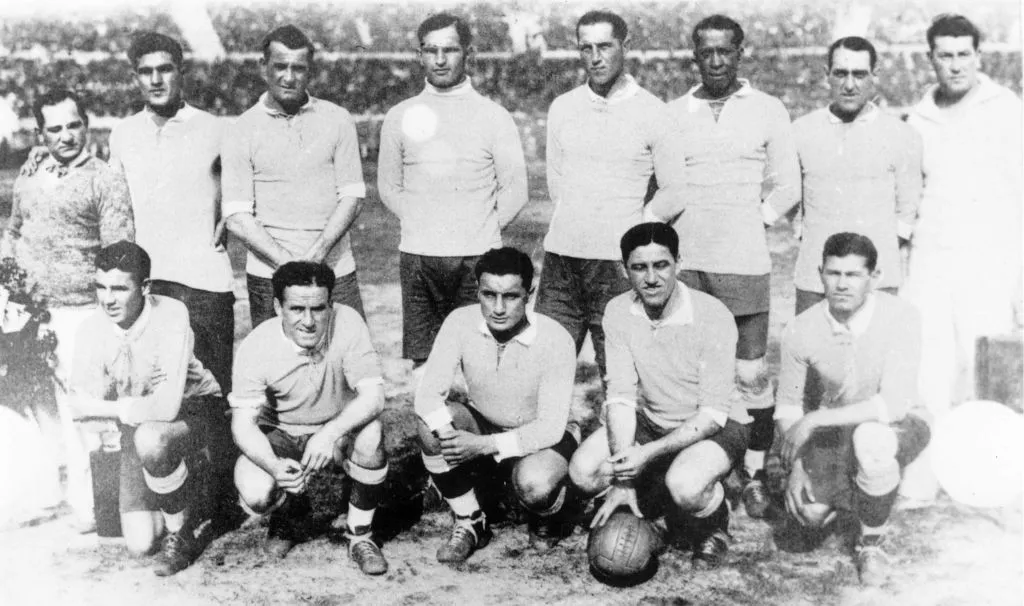
The numbers tell the story of a tournament that has grown almost continuously since 1930. From 18 matches in the inaugural tournament, the field held in the high teens through the 1930s, climbed to 26 by 1954 and reached 32 by 1970.
The 1974 tournament brought the total to 38 matches, and 1982 pushed it to 52.
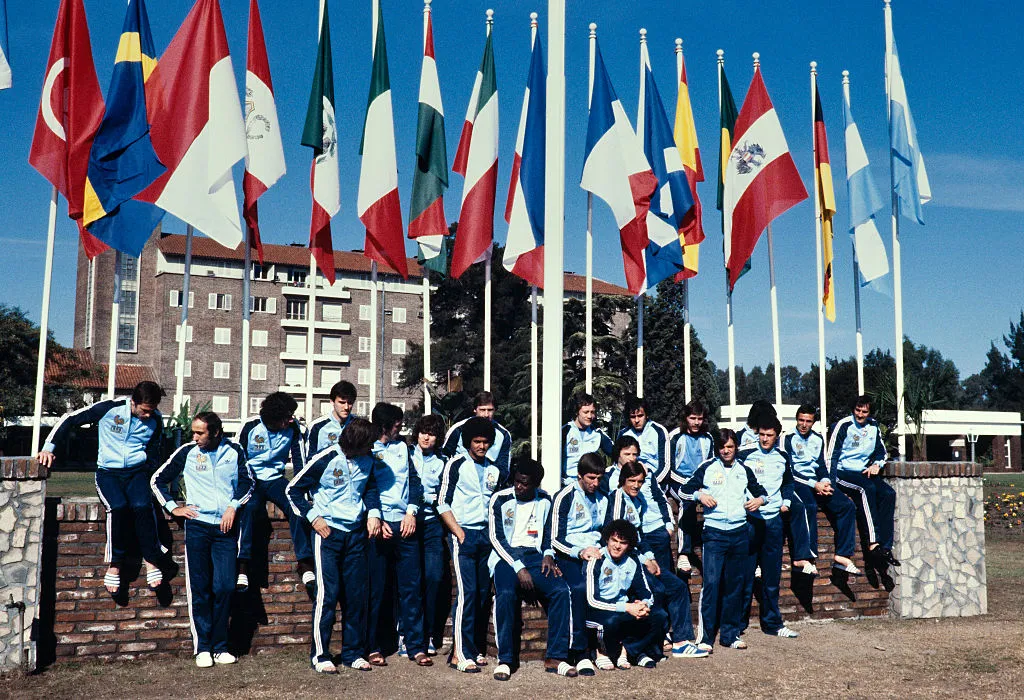
The 64-match format introduced in 1998 held steady for seven tournaments.
The jump to 104 matches in 2026 represents the largest single increase in the tournament’s history.
Could the World Cup Expand Again?
South American football governing body CONMEBOL has formally proposed expanding the 2030 World Cup to 64 teams, an idea first raised by Ignacio Alonso, president of the Uruguayan Football Association, at a FIFA council meeting.
FIFA President Gianni Infantino met with CONMEBOL President Alejandro Domínguez and South American federation leaders in New York to discuss the proposal.
A move to 64 teams would mean the 2030 edition would feature 128 matches, double the 2026 total. The 2030 tournament, set to mark the World Cup’s centennial across six host countries on three continents, would face significant new logistical questions if the expansion moves forward.






Leave a Reply