


President Donald Trump has spoken up about achieving a “perfect” score on the “high difficulty” cognitive test he recently took, so Newsweek decided to take a closer look at the questions he may have faced.
Writing on Truth Social, Trump said: “Unlike other US Presidents, none of whom have ever taken an approved, high difficulty, Cognitive Test, I scored a perfect 30 out of 30, considered ‘extreme intelligence.
“In fact, this is my fourth such test, all PERFECT or 120 correct answers out of 120 questions asked! It is very rare that anyone gets a Perfect Score, especially when achieved four times in a row.”
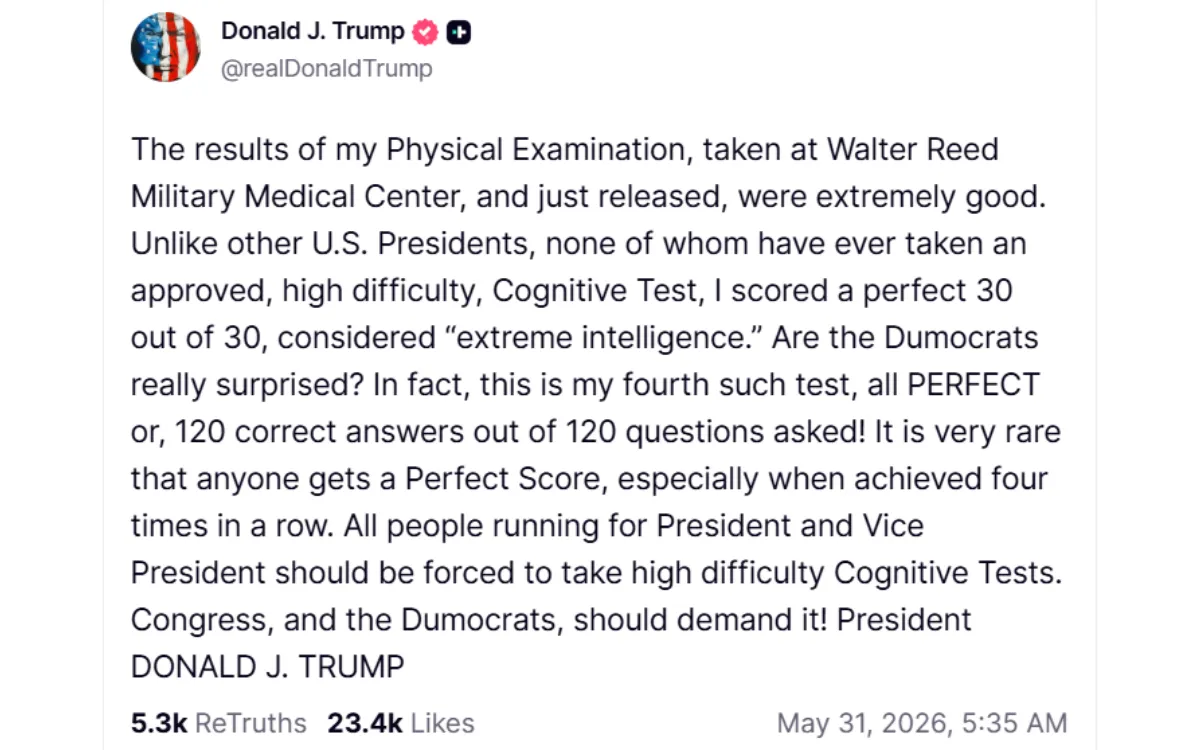
The test Trump is referencing is the Montreal Cognitive Assessment, a 30-point screening tool used by healthcare professionals and researchers to detect the early signs of dementia and mild cognitive impairment.
“All people running for President and Vice President should be forced to take high difficulty Cognitive Tests,” Trump wrote in the same Truth Social post.
With the permission from Montreal Cognitive Assessment, Newsweek is taking a closer look at a handful of the questions Trump may well have faced during his test and asking: how well would you score?
MoCA Test Questions
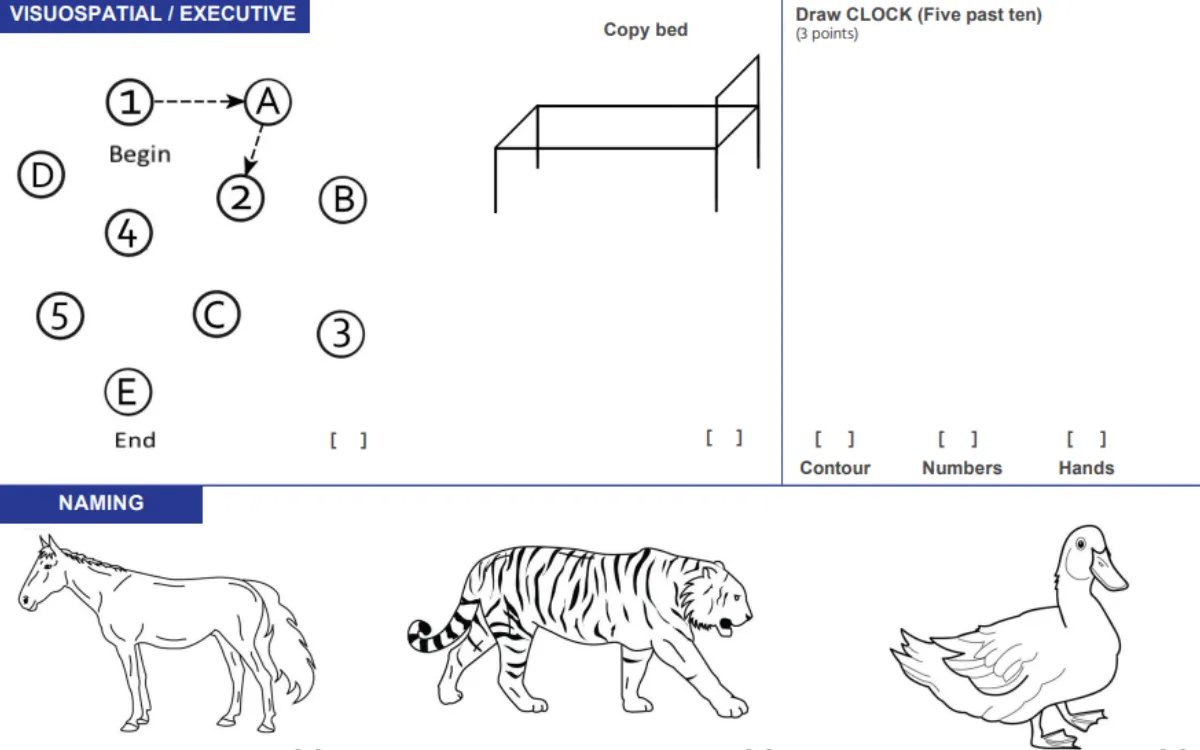
The test includes a visuospatial question asking those completing the test to follow a basic number/letter pattern. It starts 1, A, 2, and then should continue on to B, 3, C, 4, D, 5, E.
Another question asks you to copy a basic stick image of a bed, while another challenges those completing the test to draw a clock displaying the time as five minutes past 10. The correct answer would see the user draw a clock face, with the hour hand at 10 and the minute hand at 5.
These questions are followed by another in which pictures of three different animals are presented. The task is to name all three. The animals pictured are a horse, a tiger and a duck.
The Montreal Cognitive Assessment is intended for professional use only by healthcare professionals or researchers. For general public use, the MoCA XpressO test is available online as a quick screening option.
The White House’s Response
Newsweek contacted the White House for comment on Trump’s test results. They referred back to Trump’s Truth Social post discussing his test scores.
A memo recently released by the White House from Dr. Sean Barbabella, Trump’s physician, said the president “remains in excellent health, demonstrating strong cardiac, pulmonary, neurological and overall physical function.”
Barbabella also noted in the memo that “a comprehensive neurological examination demonstrated normal mental status.”
An Expert’s View
The answers may seem straightforward to most people but Dr. Leslie Dobson, a forensic psychologist with specialist training in neuropsychological assessment, says that’s the whole point.
“These tests set a floor, not a ceiling,” she told Newsweek. “They are not measures of intelligence, wisdom, fitness for high-pressure decision-making, or executive function under stress. Any cognitively intact adult without moderate to severe neurological impairment should score at or near the maximum without breaking a sweat.
“The MoCA has a maximum score of 30. A score of 26 or above is considered normal. Scores below 26 suggest possible impairment warranting further investigation. This is not a test one ‘aces,’ one simply passes or raises a clinical flag.”
Dobson also expressed concerned over the fact Trump had undergone multiple tests of this kind. “Cognitively healthy individuals in routine life are not typically administered repeated cognitive screenings. These tools are used when there is a clinical reason, a concern raised by the patient, a family member, or an observing clinician,” she said.
“The repeated, publicly emphasized administration of screening tests, combined with the apparent need to announce the results, is not standard neurological practice. It is, however, very good public relations, provided one’s audience is unfamiliar with what the tests actually measure.”
A Second Opinion
Tracy Collins, a licensed clinical psychologist, echoed Dobson’s thoughts on tests of this kind. “They are not intelligence tests,” she said. “They are designed to detect signs of cognitive decline, things like memory loss, difficulty with spatial reasoning, problems with attention or language. They check whether the basic machinery is working, not how smart or capable someone is.
“A healthy person with no cognitive impairment should score at or near the top. The test is calibrated so that a normal result is expected, not exceptional. There is nothing to ‘ace’ there really.”
Collins noted that, in her experience, repeated testing is actually “standard practice for any patient over a certain age, particularly those in high-stress or high-responsibility roles.”
“Repeated testing over time allows clinicians to track whether scores remain stable or show a pattern of change,” she said. “A single score tells you very little. The trend over multiple administrations is what matters diagnostically.”
Collins also noted that testing of this kind does come with some “limitations” “They are brief, usually 10 to 15 minutes, and they catch moderate to significant impairment more reliably than subtle early-stage changes,” she said. “A perfect score does not rule out every possible concern, and a slightly imperfect score does not necessarily indicate a serious problem. They are a starting point, not a final answer.”










Leave a Reply