

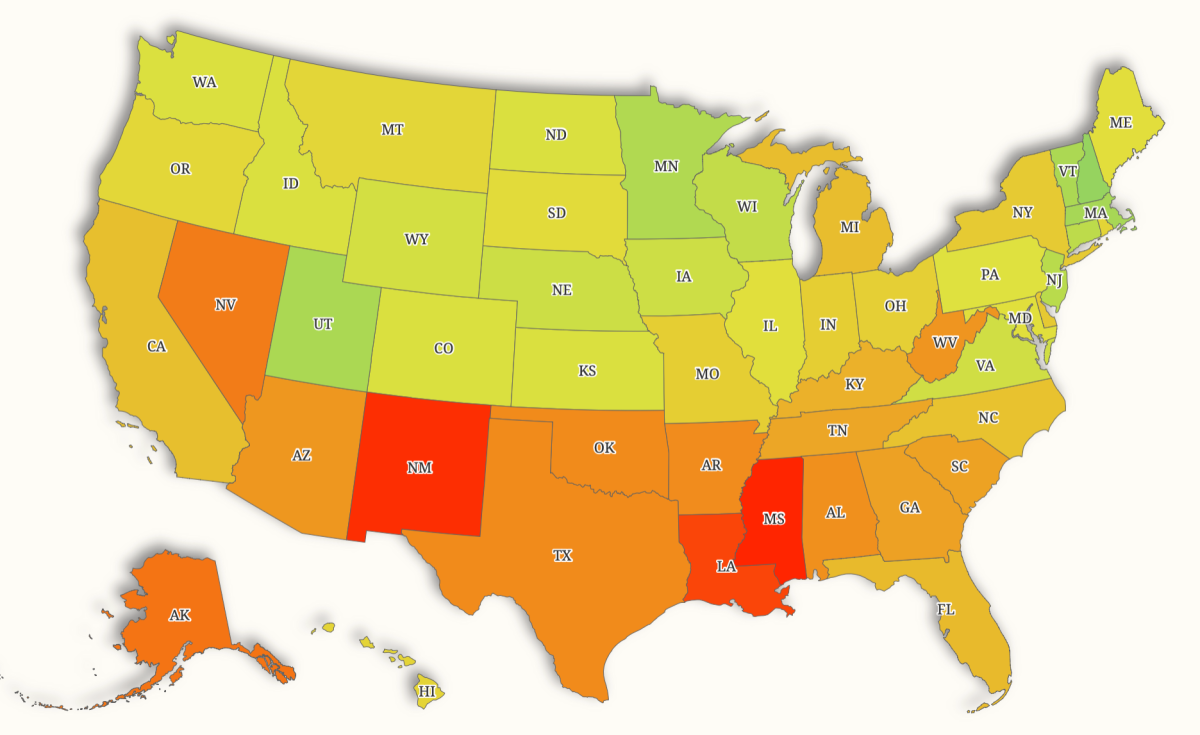
Children‘s well-being declined across much of the United States between 2019 and 2024, according to a new report that found nearly three in five states are now performing worse than they were before the COVID-19 pandemic.
The latest KIDS COUNT Data Book from the Annie E. Casey Foundation ranked states on a range of measures affecting children, from education and health outcomes to economic security and family circumstances. While some states made gains, the report found that overall child well-being nationally slipped during the five-year period from 2019 to 2024.
The report ranked New Hampshire as the best state for child well-being in 2026, while Mississippi placed last.
“Research shows that kids who are healthy, safe, fed, educated and surrounded by strong family relationships have a much better chance to thrive and contribute as independent adults,” said Leslie Boissiere, vice president of external affairs at the Annie E. Casey Foundation.
“We know that today’s children are tomorrow’s workforce so the strength of the economy in the future is tied to the wellbeing of kids today.”
Which States Ranked Highest?
The report assessed states using 16 indicators across four categories: economic well-being, education, health, and family and community.
New Hampshire topped the rankings with a score of 838 out of 1,000. It was followed by Massachusetts, Utah, Vermont and Minnesota. Five of the top 10 states were located in the Northeast, continuing a longstanding trend of stronger child well-being outcomes in that region.
Connecticut, New Jersey and Vermont also placed among the nation’s highest-ranked states.
The Midwest also performed well overall, with Minnesota, Wisconsin, Nebraska and Iowa all finishing in the top 10.
The highest-ranked states for child well-being were:
- New Hampshire
- Massachusetts
- Utah
- Vermont
- Minnesota
- New Jersey
- Connecticut
- Wisconsin
- Nebraska
- Iowa
Nationally, the overall score stood at 547, compared with New Hampshire’s 838. The Granite State also ranked number one for children’s economic wellbeing, health, and family and community.
Lowest-Ranked States
At the other end of the rankings, Southern and Western states were disproportionately represented.
Mississippi ranked 50th with a score of 271, followed by New Mexico and Louisiana. Alaska, Nevada, Oklahoma, Texas, Arkansas, Alabama, West Virginia, Arizona and Georgia also appeared among the lowest-performing states.
The 10 lowest-ranked states were:
- Mississippi
- New Mexico
- Louisiana
- Alaska
- Nevada
- Oklahoma
- Texas
- Arkansas
- Alabama
- West Virginia
According to the report, regional disparities remain a defining feature of child well-being in America. Researchers said there are “persistent disparities across states and communities, driven by differences in policy, economic conditions, infrastructure, resources and neighborhood characteristics.”
Those differences, the report said, affect access to necessities including healthcare, education, housing, healthy food, clean air and safe environments.
Education Driving National Decline
The national child well-being score fell from 553 in 2019 to 547 in 2024. Overall, 29 states and the nation as a whole recorded worse child well-being scores than before the pandemic, while 15 states improved and six remained unchanged.
Education was the area showing the broadest decline. Forty-seven states performed worse in 2024 than they did in 2019, highlighting what the report described as the lingering impact of pandemic-related learning disruptions, particularly in reading and mathematics.
About 70 percent of fourth-graders, equivalent to at least 2 million children, are not reading at a proficient level, compared with 66 percent in 2019, the report found. Math performance among eighth-graders also worsened, with 73 percent failing to reach proficiency, up from 67 percent five years earlier. Early childhood school participation has slipped as well, falling to 46 percent of children aged three and four, down from 48 percent in 2019.
North Dakota, Maine, Delaware, Iowa and Oklahoma experienced the largest declines in educational outcomes. Only Louisiana and Mississippi recorded improvements in education during the period, while South Carolina remained stable.
The top ranked state for education was New Jersey, followed by Massachusetts and Connecticut. At the other end, New Mexico was ranked as the worst, then Alaska and Oklahoma.
Winners and Losers Since 2019
Although national performance slipped overall, some states made good progress.
The report found that Southern states gained the most ground regionally, with eight of the 15 improving states located in the South: South Carolina, Louisiana and Kentucky led those gains. However, Northeastern and Midwestern states experienced the largest overall declines. Maine recorded the steepest drop in child well-being since 2019, followed by Nebraska, North Dakota, Iowa and Minnesota.
Health outcomes also moved in the wrong direction in many parts of the country. Twenty-six states saw declines in children’s health measures, while only 10 improved. Maine and Mississippi experienced the largest setbacks, while Virginia, Indiana and New Jersey posted the strongest gains. Overall, the worst state for children’s health is Mississippi.
There were more improvements across economic well-being for children. Twenty-nine states improved, but still, the report found 13 states have declined on that metric. Rhode Island recorded the largest decrease in economic well-being, followed by Nebraska and Tennessee. Delaware, New Mexico and New Hampshire saw the biggest gains.








Leave a Reply